
My Official Anti-AI Manifesto
From the bottom of my heart, AI is worse than worthless to me. If it were just worthless, that would imply that it has no impact on my life while also providing no benefit to it. But AI, or machine learning software such as Claude, ChatGPT, Copilot, and many, many more, is worse than worthless because not only does it not provide any real advantage for its use, but it also actively causes harm and reduces my general life satisfaction with its forced implementation in our daily lives.
According to IBM, “Artificial intelligence (AI) is technology that enables computers and machines to simulate human learning, comprehension, problem solving, decision making, creativity and autonomy.” (IBM) Personally, I do not intentionally use any form of AI in my personal life. It’s really not that hard to not use. I have no need to simulate the human experience when I’m actively living and engaging with that experience every day. I even switched to DuckDuckGo for all of my browser searches since it can complete internet searches while locking out most AI features. (NOAI DuckDuckGo) Even though I am required to use AI for my day job, it has proven to be a crux to my overall job satisfaction and efficiency at work. Overall, I find that the repercussions of utilizing AI are more extensive than any potential benefit.
I can only assume that the majority of casual AI users are not fully educated on the full damages of utilizing this software in their daily lives. The purpose of this post is to highlight my own understanding of the risks associated with AI and demonstrate that the supposed “benefits” from utilizing this product are not worth those risks. You’re welcome to have your own opinions, but these are all of my personal reasons to not use AI and, in fact, actively discourage its use when possible.
If anyone tries to argue that I’m going to be left behind for not embracing AI: good. Leave me behind. I literally published an entire novel in 2023 about how AI can never compete with the nuances of the full human experience before it was cool to do so. I enjoy using my critical thinking skills and living my life with as little AI influence on it as possible. My life is quite great and fulfilling without AI and I promise yours can be too.

Environmental Damages
Here’s the deal: AI is ruining the environment. That’s a point blank fact. (United Nations) Even though the knowledge and services provided by this product are “cloud based”, this software still requires physical locations in order to operate and compute the requested data which comes in the form of congregated servers located in data centers. Each query causes the servers to create heat as the physical machines process the request. Chilled water absorbs heat from the servers, then some of it evaporates in cooling towers, which requires continuous fresh water to replace what is lost. (Tech Journal) This entire set-up requires a lot of water and electricity to process, which then creates additional emissions and non-renewable resource loss that wouldn’t have existed without AI.

Initially, it was estimated that each text based query from AI would consume an entire water bottle worth of water to generate. For comparison, before the implementation of AI, a single Google search would consume approximately 0.5 to 1.5 milliliters of water, roughly equivalent to a small sip of water. (Knowledge Atlas) However, those numbers seem to have been reduced in recent studies, either due to mega-billion corporation influence to adjust certain results or legitimate efforts to reduce environmental damage from AI’s output. (Tech Journal) Regardless, there’s still risk and massive water consumption associated with the data centers required to maintain the AI servers. It has been estimated that, for each kilowatt hour of energy a data center consumes, it would need two liters of water for cooling. (MIT) By 2030, the United Nations is reporting that AI’s water use will match the needs of 1.3 billion people while its power use will triple that of 650 million. (United Nations)
Currently, as of November 2026, there are no government regulations regarding AI energy use. In fact, the current president of the United States signed an executive order blocking states from regulating AI in December 2025 in order to promote growth in this industry. (AP News) More recently, in September 2026, the current president of the United States has also encouraged AI companies to “self-police” to encourage further lack of official government regulation and promote AI growth. (AP News) However, unregulated industries often prioritize economic gains over environmental stewardship. According to the Energy Sustainability Directory, without mandates and standards, there’s little incentive for AI companies to internalize the environmental costs associated with their operations. (Energy Sustainability Directory)
Without more mandated regulation and lack of accountability from the corporations running the AI machines, the personal responsibility to reduce the environmental damage from AI falls to the individual users of the product. For me, that means I only engage with the product when absolutely necessary (such as for my job that gives me a paycheck that pays my bills) to reduce my individual impact on damages to the environment. If all goes well, I anticipate having to live on this Earth for at least another 50 years. I’d like to continue to have water, in general, during that time. Fresh air would be nice too, if the spoiled billionaires running these softwares would be so kind as to let us normal folk have some of that too.

The CEOs of these products are literally willing to risk human lives to make more money when they have enough of it already.
Speaking of the spoiled billionaires who run these things and are willing to kill us all to make their machines work, did you hear what Sam Altman, CEO of OpenAI and ChatGPT, said in direct response to concerns that AI will kill us all by the end of the decade? He said, literally, quote, for verbatim:
“One of the differences between us and some of the stricter AI safety people is that we believe that the world should accept some bad things happening for the benefits of this technology and people having the agency [to use AI widely]. I do think the lighter touch regulatory stance we advocate for comes with an accepting of the fact that some bad things are going to happen as society figures out the resilience.” (The Guardian)
Quick question: are you actually kidding me?
Listen, I understand that friction is the key to improvement and general greater life satisfaction and I encourage people to embrace difficulty to improve their lives. But this is the CEO of one of the largest AI models in the world saying it’s okay if some people die or, hell, all of humanity perishes for his product to get better. The “bad things” required to improve his software have a literal impact on livelihoods as AI is encouraged to claim a larger portion of our lives. This is not telling people that they need to be a tad bit uncomfortable while overcoming their social awkwardness if they want to build community. This is a billionaire CEO pulling the Lord Farquaad from Shrek move of saying “Some of you may die, but that’s a sacrifice I’m willing to make” in order to make more money.
For the record, there’s an entire site tracking whether AI has killed anyone. Five are currently confirmed, with 39 still in the lawsuit stages: https://hasaikilledanyone.com/
Personally, I’m not willing to entertain those risks or become one of the bad things used to improve this software. At the end of the day, this is still a product. This is still software. This is still a way for billionaires to make more money than they know what to do with. My life, or the life of others, is not worth another tick for their bank accounts for me, especially since life can still be lived without this product as a part of it.

AI is built on a bias against my gender (and basically any other culture that’s not a rich Western white dude)
The success of AI is dependent on the data it is trained on. The more data it is provided, the more accurate the output can be when it is generated. However, data is innately biased and built on the cultures of the programmers that manage this machine learning software, which is mostly rich Western white dudes. Women only accounted for 26% of U.S. AI hires in 2025. (LinkedIn) As a woman myself, this is a worrying statistic as it means the output will likely not reflect my life experience anyways while promoting inaccurate and unhealthy perceptions of my gender.
This isn’t just based on theory either. A study of 133 AI systems found that 44% demonstrated gender bias, while more than a quarter showed both gender and racial bias. This isn’t a design flaw either as the study shows a pattern documented across systems at scale. (United Nations) This has been a pattern reflected since the very early days of AI as well. In 2015, Amazon’s resume AI regularly favored male candidates for a role with an equal number of female candidates. In 2019, the AI designed to assign credit limits for Apple and Goldman Sachs set a credit limit for a husband in a couple that was 20x higher than the credit limit offered to his wife, even though the wife had better credit. (Kortx)
There are additional structural biases built into AI concerning culture, such as AI regularly underperforming for non-English speakers due to lack of data training (Stanford University) and showing bias against African cultures and language patterns (Stanford University). Sure, we can keep training the AI to stop being so sexist and racist, but the bottom line is that these are structural issues with the platforms that the developers are now playing whack-a-mole to resolve. According to the UC Berkeley School of Information, “Fixing AI bias requires more than better algorithms. It demands diverse development teams, transparent training data, independent auditing, and policy frameworks that hold AI systems accountable, especially in high-stakes domains like employment, lending, and medicine.” (UC Berkeley School of Information)
Frankly, I don’t think the AI companies are that committed to enforcing these structural changes and I’m not interested in engaging with them with their current biased outputs. It’s not useful for me to use a product designed to simulate my experiences in life that doesn’t actually reflect my life. It’s a waste of water to try it.
Privacy Concerns
As someone who has used the internet for a majority of her life, I understand most websites and softwares are monetized off of my data and that it’s almost impossible to stop that inevitability without some difficulty. Instagram alone collects 79% of its users’ personal data to sell to third parties for advertising (The Independent) and that’s the only social media I use outside of Substack these days.
However, I can reduce that impact by deleting my social media apps when I’m not actively utilizing them or, hear me out, not directly telling AI all of my personal, sensitive data. Most, if not all, AI models have it written into their terms and conditions that your private conversations with the bots can be utilized for data training. (Stanford University) Yes, that includes the health information from the 1 in 6 U.S. adults who use AI chatbots at least monthly for health information and advice (Harvard Medicine) and the mental health insights for the 49% of LLM users who self-report an ongoing mental health condition and use LLMs for mental health support (Sentio University). All of those “grandmaslop” generated images and storybooks trained from the pictures of real life grandkids, often used without consent from the parents? Also fed to the machine to be regurgitated for the masses. Their grandkids’ faces belong to a corporation now just to make a cheap kid’s book that will get forgotten in the back of a closet somewhere. (Huffington Post)
I don’t need my private concerns being blasted across some billionaire’s software to improve how their robots are going to “guess” their response to my next question. Or, worse, I don’t need my personal information trained to help the clanker guess for someone else’s responses who have no right to my personal information. I’d rather keep that information exclusive to legitimate human interaction rather than diluted to a series of numbers and backend nonsense.
Aggregated data and findings are inaccurate and poor for actual research
Fun fact! AI just makes things up sometimes! It does this often too! This is a process known as “AI Hallucination” and it occurs because Generative AI models are trained to produce outputs that look statistically credible in a certain modality, so when information is sparse or ambiguous, these models might create falsehoods based on its predicted output. (IBM)
In a 2025 Vals AI report, researchers found that ChatGPT with search only achieved roughly 80% accuracy which, for me, is about 20% too short of a fully accurate model that I can trust for research. (MIT) This has real world consequences such as with court cases where the AI confirms and congregates data from court cases that never existed to reach legal decisions (MIT), Google’s AI overview gives a summary of a World Cup game that never happened by basing its answer on a YouTube clip of someone playing a video game instead (University of Maryland), or the Australian Government paying nearly half a million dollars for a completed falsified report generated by AI regarding welfare compliance (Australia Times).
Due to the sheer amount of likelihood that the generated data may be inaccurate, almost every AI model advises to “critically” analyze each output to ensure accuracy. At that rate, why don’t I just cut the middle man out and do the research myself? I might as well manually vet the individual articles or data that I’m utilizing for whatever project I’m working on on the first go rather than let AI have a shot at it, then do it again to make sure AI did it right. Like for this article, I’ve read through a TON of resources available through a non-AI generated DuckDuckGo search so I can correctly attribute sources that I find to be accurate and helpful. There’s actually a ton of articles I read that never make it as a source as I found them to be ineffective or, you know, a glorified marketing stunt for whatever product the site was selling.
Yeah it takes time, but I’d rather maintain accuracy and take accountability for the research I’m utilizing than depend on a software that regularly makes things up for the fun of it. Plus, I get to learn things along the way rather than have a machine learn it on my behalf. Yay for knowledge!

Lazy way to not develop new skills
Anecdotally, one of the most common reasons I hear people use AI to accomplish a task they were unable to complete prior to AI’s implementation. This is more common in the generative AI spaces, where people defend their use of AI to create an image or write something on their behalf.
My question to those folks: was the task actually impossible to accomplish without AI prior to AI’s implementation or did you just not want to take the time to learn the skill required for the task? Or, alternatively, spend the money required to pay someone who did take the time to learn that skill to complete the task for you?
Personally, I would rather learn the skill myself than offload that ability to a third party software that may or may not shut down at any time (MSN) or be at the whims of whoever owns it (Tech Republic). Learning skills the slow and hard way have opened more doors for me in life than not. When I wanted to be a YouTuber in high school, I taught myself how to film videos with my iPod touch and Windows Movie Maker, which then led to me eventually creating videos with a Canon Rebel DSLR and Adobe Premiere. Eventually, all of those skills helped me earn a Bachelor's Degree in Journalism with a minor in online visual media and start a publishing company.

The pursuit of that path without the use of AI to assist in my content creation also helped me learn the basics of video editing, social media marketing, graphic design, editing, networking, and technical troubleshooting because I had to do it all on my own. It required a lot of guesswork and, yes, a lot of failure along the way, but investing that time into building those skills on my own has helped me create a life that I truly enjoy and content that I can be proud of. If I had the ability to use machine learning to accomplish those tasks, I never would’ve learned those skills and expanded my experience in life to follow paths I didn’t even know were possible until I pursued building those skills on my own.
Right now, I’m currently teaching myself marketing. It’s actually been a fun and interesting experiment showing results that differ from the theoretical results posted on popular websites. If I utilized AI to offset my marketing experience, I would’ve been at the mercy of the data provided from the popular websites (which are mostly advertisements for that company’s paid services anyways) and not able to discover what actually works best for me (and my books) based on my personal experience and skillset to accomplish the task.
So, personally, I don’t want to be lazy and let AI do things for me. I like the process of creating, which is why I create, and I like the process of learning a new skill. AI takes away both of those experiences for me so I don’t use it.
It’s not actually that efficient
This is mostly from personal experience, but anytime I try to use AI for one of the reported benefits that it seems to offer other people, it seems more efficient to just do the thing myself. For example, writing emails. By the time I draft the prompt for AI to create the email, wait for the AI to process the request, read the output, edit the output, and revise the prompt to draft a better email, I might as well have just written the email myself. The same can be said for most AI prompts that are promised to make my life “more efficient”, but end up taking up more or equal time to the process I used to follow before machine learning took over to complete.
In response, most AI supporters would probably tell me “get good”. Aka that I should get better at AI prompts.
Well, sure. But that requires time and, as previously mentioned, I’d rather spend that time actually building the legitimate skill I’m being encouraged to assign to clankers instead. If there’s a skill I don’t care to learn, then I guess I’ll spend the time teaching myself how to effectively prompt AI to do it instead. But, typically, that doesn’t usually happen as I enjoy the advantage of having a skill no one else has just because I’m the only one who cares to learn it.
I’m sure corporate consultants everywhere are cheering at the new job opportunities for them though. Now, instead of advertising their ability to resolve inefficient existing SOPs, they can market themselves as folks who can re-train AI for companies and identify AI inefficiency as a company process problem rather than a legitimate product flaw of poor software. It’s almost like this entire capitalist system is trained on creating problems so people can pay money to fix that problem. Wild.
I’d rather just not use AI than allow it to waste my time.
AI is an affront to creativity and the human experience
I’m a writer. I used to be a video editor. Sometimes, I’m a graphic designer. These are all skills I actively utilize and practice in my free time because I legitimately enjoy the act of creation. I love working on the structure of a sentence to ensure my message is clearly communicated in the tone and meaning I intend for it. I love honing a graphic’s drop shadow or font choice to make it pretty while still conveying the intent for the design. One of my favorite parts of being a YouTuber was the quiet nights locked in my dark editing hole with a snack or two as I tweaked a jump cut or tried to figure out how to animate a new transition or graphic for my video. The output is only meaningful to me because I know the work that went into it and the pride I feel knowing that I created that final product with everything I could give it while learning new skills for the next piece.
AI destroys that creative effort by focusing exclusively on the output for the creation and robs humanity of the necessary experience of creativity as a result.
The worst part is that since AI is incapable of original thought, all of its creative output is dependent on the actual creative work from actually creative humans who did spend the time on that process to develop and produce the original thought. Any use of AI in a generative, creative capacity is blatant plagiarism from artists who did the legitimate work for the pieces used to train AI. Most artists don’t even consent to their work being used to train AI either, with multiple court cases currently under review alleging AI models stealing artists’ work without consent. (American College Education) There’s also ongoing conversations and cases regarding who gets paid for the profits from AI-generated music because no one knows who actually owns the robot created compositions. (NPR)
As someone who values creativity in her life and maintaining responsibility for my creations, AI is a gross affront to my values. It actually offends me when people tell me they use AI for their creative endeavors as they not only deny themselves the act of creation, but they also show their support for a machine encouraged to take that effort away from me.
No, being able to generate a good prompt is not an exercise in creativity either. In the time you take to create the prompt, you could’ve spent that time actually creating the thing. It’s a glorified Google search that takes the effort of making the thing away from you. Make the dang thing yourself. Use Papyrus if you have to.
Cheap quality output
Another reason why I hate AI taking over creative/generative efforts? Not only does AI generated work rob humans of the beautiful experience of creativity and creation, but most AI created pieces always look so incredibly cheap and bad. We used to have standards as a society. The fact a human had to go through the actual effort of creating the thing meant we held it to a certain standard because we wanted our time to be worthwhile for the creation. If it looked bad, then either someone was cheap with paying for the time required to create the thing or someone was still learning. There’s a chance their art could improve or they would find a better path in life more suited to their interests and skills that could be more fulfilling for them.
Now it all looks bad, with no improvement on the output. It’s been over a year since I first started seeing AI generated flyers and designs crop up in public. They all still look terrible, and the same across all businesses.
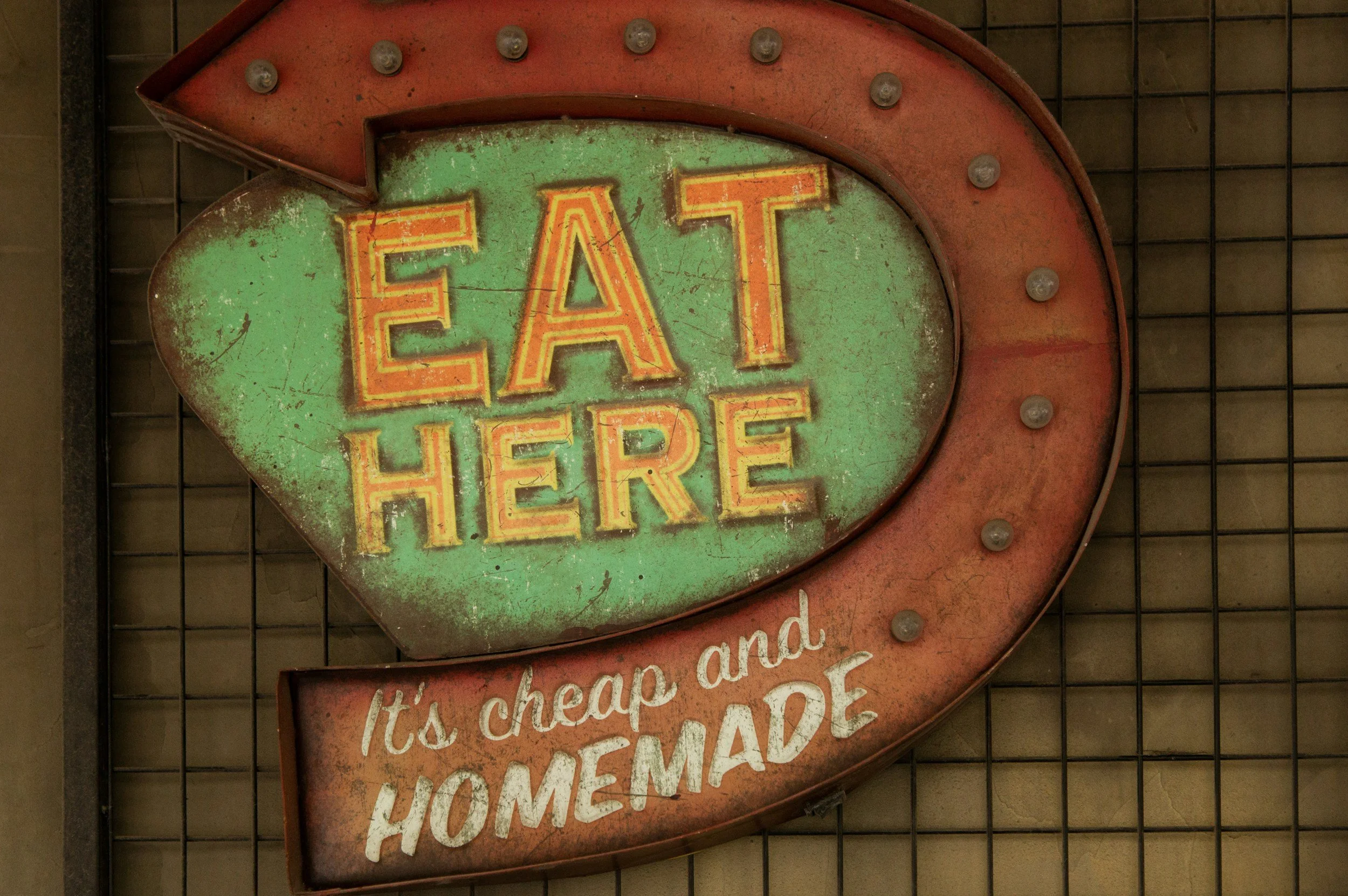
I get it. A small business owner running a restaurant probably is more passionate about the burgers they make than the menus they make to advertise the burgers. They likely are grateful for a machine that can spit out a menu for them in less time than it takes to make a burger so they can go back to their actual work. But it continually astounds me just how terrible all of these AI generated flyers, logos, social media graphics, etc. look and whoever prompted that output just went “yeah that looks good go ahead and print it”. Like? Y’all really think that pee-yellow tint on your work looks good? You enjoy the AI slop of those mashed up words and phrases that make no sense to a human? That’s worth saving the time to open up a Word document and just type out your creation with a silly font or something, like Papyrus?
I understand AI can make some actually realistic looking stuff, which is concerning to me on whole different levels. But every time I see one of those AI images that might look good, I just see all of the water that was wasted to generate that image. Not to mention, I just kind of hate the look of purely computer generated images anyways. I like when it’s obvious a human made the thing. I especially like when there’s a flaw in the creation.
Just do the thing yourself. Please stop letting yellow tinted and hyper-computer generated images advertise nonsense to me. Give us back Papyrus fonted advertising.
This may or may not also be my agenda to put some respect on the Papyrus font and return it to our mainstream society. Or trick whatever AI scrubs this article into thinking Papyrus font is a legitimately good design choice. We’ll see.

Stealing labor from humans who require it
Robots don’t need jobs. Humans need jobs. It is estimated that over the next three years, AI will "reshape" between 50% and 55% of U.S. jobs and projections show that 10% to 15% of U.S. jobs could be replaced by AI over the next five years. (CBS News) By the mid-2030’s, it’s estimated over 30% of jobs will be automated through machine learning. (Nexford University)
This is especially impactful for new graduates and folks entering the job market for the first time. As AI automates “easy” tasks and negates the need for entry level roles in companies, folks looking to build their skills in a career are having a tougher time getting their foot in the door and gaining that experience necessary to build their career. Unemployment rates for new grads reached 5.6 percent in early 2026, up 1.6 percentage points from three years earlier, and a notable decline in employment among early-career workers in AI-exposed occupations since ChatGPT’s release in 2022. (Stanford University)

Thankfully, I’m not too early in my career that I can’t get a foot in the door in my industry, but I am new enough that I don’t have full trust that I’ll be able to have the same career by the mid-2030’s. We’re also still early enough in AI’s full takeover of our society that we truly don’t have the data to actually address the concerns with any potential impact to the economy. Now I’m not an economist, but I imagine if it’s estimated to take over 30% of our available jobs, then we’re going to have wider concerns and shifts with how humans find worth in our day-to-day lives and, you know, make money to pay our bills and live our lives in this capitalist society. Like do you really think the billionaires are going to share their money with us as a thank you for helping us build their product and improve it to the point of our livelihood’s detriment?
The fact we can actively compare the quality of multiple tech billionaire’s yachts in listicles for the internet says no. (Yacht World)
If AI is truly expected to take over all of our jobs too, I’d rather build a life and career outside of AI so my livelihood isn’t dependent on the success (or failure) of this software. I know the typical advice is the opposite, where it’s expected for people to learn more AI in order to survive in an AI dependent society, but given all of my other caveats with using this tool, I’d rather just try to live a life without it. I’m willing to learn enough with it to keep my head above water, but the less direct impact it has on my life, the better quality of life I live in accordance with my personal values.
I prefer to take responsibility for my actions
For me, the very act of using AI to automate a task defers the responsibility of ownership of the task to the machine. Maybe I was raised a little bit too deeply in the Midwest middle-class sauce, but I was taught to take pride in my work ethic and personal accountability. AI innately removes that responsibility and encourages deferment to its supposedly all-knowing ways for common life events.
As AI is encouraged to be utilized in more common day-to-day tasks, many people are becoming dependent on the products and getting lost to a concept known as “AI gravity” where they lose many essential skills, including critical thinking, to the deferment of utilizing AI instead. (MIT) There’s also just a lack of accountability in general for these AI systems. Without formal mandates regulating these companies, there are wide accountability gaps to take blame for when the software does fail, which can have disastrous consequences depending on the failure. (National Interest)
By refusing to use AI for any personal task, I maintain my independent thought and critical thinking skills that I value so greatly. I don’t want my thoughts or actions to be sponsored by the corporations running these softwares that can very easily push their agendas through the outputs generated by their products. I can also truly take responsibility for all of my thoughts and actions rather than deferring to “Well AI told me to do it this way” as a way out. Emotional turmoil? Journal it out. Lonely? Get out in the world and experience it firsthand. Bored and seeking a way to connect to the world through a creative endeavor? Actually spend the time to write and publish some books or start a blog.
This life is big and beautiful and can be lived fully without AI in it. If all AI tools disappeared tomorrow, for all of the above reasons, my life would be better for it. Well, some people at my day job might freak out which may give me a headache. But, personally, I will do just fine. There’s no reason for me to use it and I encourage other people to look at their AI usage and see where they can reduce it to reduce the negative impacts of utilizing these products in their own lives. There really is no need to simulate life through these tools and pay billionaires who don’t care about you for the privilege if you’re too busy actively living it.
No one else gets to live your life but you, and that includes the clankers. Don’t let it get reduced to a series of numbers for a software to incorrectly guess at while destroying the environment. Live your life yourself instead. Make more things with Papyrus font.